I am text block. Click edit button to change this text. Lorem ipsum dolor sit amet, consectetur adipiscing elit. Ut elit tellus, luctus nec ullamcorper mattis, pulvinar dapibus leo.

How is AI changing the workflows and collaboration in a software agency? And how do you build a start-up with an AI-native approach?
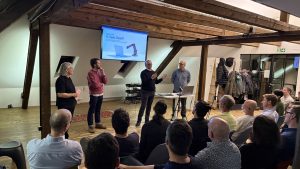
Panter and SCAIT offer insights into how they work and the workflows they use.
At Panter, Jay Péclard (Senior Developer) shows how the use of AI concretely impacts day-to-day project work – from development and collaboration through to new forms of efficiency and decision-making. He shares practical insights from client projects, where AI is increasingly becoming an integral part of development, testing, and knowledge management. Panter has been building digital solutions for companies, organisations, and start-ups for more than 20 years.
Nicolas Hoferer (Co-Founder of SCAIT) brings the perspective of an AI-native start-up: SCAIT is developing a platform for construction companies that uses specialised AI agents to analyse large volumes of tender and contract documents, identify risks, and automate processes. He offers insight into how a young tech company is built from the ground up with AI in mind – and how product development and organisation change when AI isn’t just a feature, but the foundation of the entire way of working.
With an open Q&A, apéro, and conversations afterwards.

Together with Digital Shift, in February we tackled one of the most compelling questions in tech right now:
Does the classic SaaS model still have a future?
Date: 25 February 2026
Location: Impact Hub Zürich (Loft Corner)
Moderation: Walter Diggelmann
Speakers: Andreas Goeldi-Hein & Felix Bünning
Panel: Loïc Schülé
When software becomes a commodity
The evening started from a provocative but increasingly relevant thesis: if AI enables virtually anyone to build software today – what does that mean for Software-as-a-Service providers?
The rapid evolution of AI tools is fundamentally changing the rules of the game. Development cycles are getting shorter, barriers to entry are falling, and teams can replicate features in weeks that used to take months or years. As a result, software is becoming a commodity in many areas.
Why still pay for software?
At the heart of the discussion was the question of why companies should continue to pay for software subscriptions when AI-empowered teams can build their own solutions.
One thing became clear:
Value is shifting. Away from pure functionality – towards integration, trust, speed, and specialisation.
SaaS products need to offer more than features:
A new reality for software companies
The discussion also highlighted how competition is changing:
If an almost unlimited number of providers can emerge, attention becomes the scarcest resource.
For software companies, this means:
At the same time, new opportunities are opening up for start-ups:
It has never been easier to test ideas quickly and bring products to market.
Conclusion
Whether SaaS is «dead» was deliberately left open – but one thing became clear:
The model is under pressure and continues to evolve.
The winners will be those who don’t just deliver software, but create genuine, lasting value – in a world where features alone are no longer enough.

No more exam panic and all-night cramming without a plan! When time is running out, the only strategy is often to have the courage to leave gaps – but until now it has been a game of chance.
In this pan.talk, Michele Romano and Michael Sandmaier present a solution to this problem with their AI coach of the same name. They go into the details and explain how the MVP they have developed optimizes the learning process in a targeted manner.
The innovative approach was not only awarded 1st place at the ZHAW “BotWerkstatt Hackathon“, but is also based on the completely open language model Apertuswhich was developed by ETH and EPFL. Instead of generic advice, such as that provided by ChatGPT, the AI coach takes a radically new, mathematically optimized approach.
It calculates a realistic day-by-day plan based on the study materials, the time available and the individual’s level of knowledge. For the first time, this shows precisely which gaps in knowledge you can afford to leave in order to pass the exam.
As a follow-up to the Swiss {ai} Weeks, we are inviting you to a workshop aimed specifically at SMEs from the Bern region.
In den Swiss {ai} Weeks haben über 150 Partnerorganisation und hunderte Hacker*innen in der ganzen Schweiz Lösungen entwickelt. Die Erkenntnisse der fünfwöchigen Weeks fliessen in diesen Workshop für den KMU Standort Bern mit ein.
In the half-day workshop “AI for SMEs – from buzzword to your AI plan in three hours”, we show how AI can be used in everyday business life today – without technical expertise, but with a clear practical focus. Together, we identify processes that can be simplified or improved by AI and develop initial, realistic application ideas.