
Is there a digital menu guidance system for sustainable nutrition?
by “FOOD2050”

FOOD2050 is a Zurich-based start-up with the aim of reducing global warming through sustainable eating habits.
As food production is responsible for 32% of greenhouse gas emissions worldwide according to a trend analysis by the FAO (Food and Agriculture Organization of the United Nations), FOOD2050 actively supports catering businesses and consumers in achieving global climate targets.
FOOD2050 makes the effects of food consumption visible.
By using a digital menu guidance system, recipes with a minimal ecological footprint are promoted, which should change customers’ consumption habits in the long term.
Winner


Successful piloting at ZFV
The ZFV cooperative, a leading Swiss restaurant and hotel company, has been won as a pilot partner for the Food Impact platform.
In January 2022, the project started with a pre-pilot in the University of Zurich‘s Irchel canteen. Climate-friendly menus have already been offered there. Now the climate savings can be visualized directly via the digital information system at the point of sale (POS).
By the start of the 2022/23 winter semester, we had developed a minimum viable product (MVP) together with FOOD2050 and significantly expanded the pilot operation in collaboration with the ZFV cooperative. The digital menu guidance system makes it possible to provide all relevant information centrally – from nutritional information to complete recording of the consumption of all meals served on site. This makes the climate impact transparent for guests and the company, leading to more conscious and sustainable consumption.
The challenge of transparent data
As an integral food impact platform, FOOD2050 brings together the enormous, often isolated data volumes of modern gastronomy, consolidates them and makes them visible to businesses and consumers.
The platform acts as a link between complex supply chain information and comprehensible communication. The aim is not only to calculate scientifically assessed CO2 equivalents, but also to translate them into a key figure that is intuitively understandable using the FOOD2050 climate impact model: degrees Celsius.
FOOD2050 thus creates a basis for orientation for all players in the food system.
”Panter feels like our outsourced CTO: they have remained agile in the complex development process and have built up a scalable MVP toolbox. The strategic exchange with the technical experts is also particularly valuable.
Christian KramerCEO und Co-Founder FOOD2050
The digital menu guidance system in operational use
From the flow of goods to climate indicators
At the heart of the system is a sophisticated calculation model. The process begins in the merchandise management system (e.g. Necta), from where the data is transferred to the database of the partner company Eaternity database. Eaternity calculates the ecological footprint of the food, whereupon this data is fed into the FOOD2050 system via API.
A key advantage for operations is the automation: the complex calculation of the ecological footprint takes place in the background. As the data is transferred automatically via interfaces, the manual effort for the restaurants is minimized and the benefits maximized. The transformation then takes place within the platform:
- Aggregation: Daily sales and transaction data are aggregated before visualization.
- Conversion: A specially developed arithmetic system processes this data and converts the footprint of each menu into the global warming potential (degrees Celsius).
Interaction at the point of sale
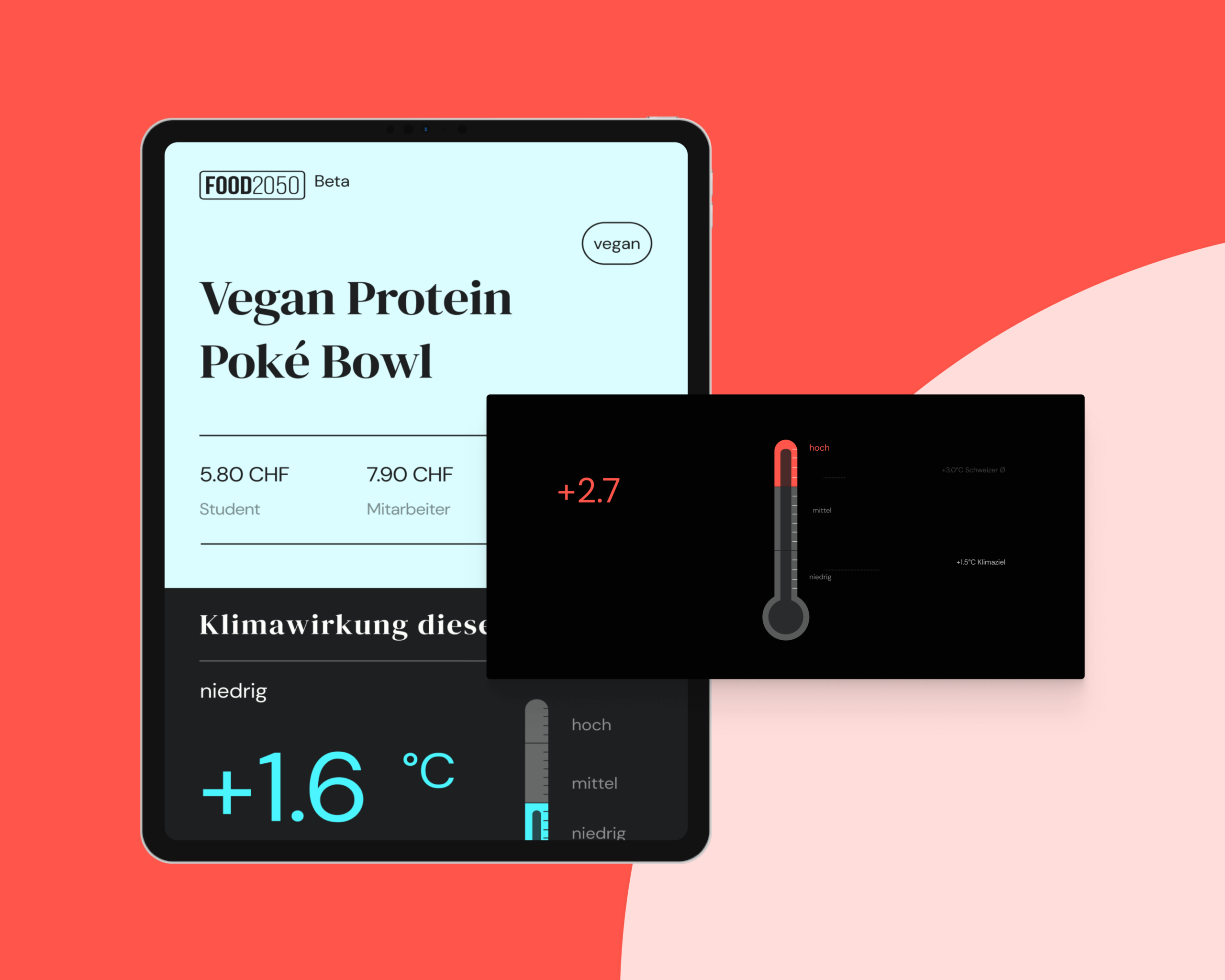
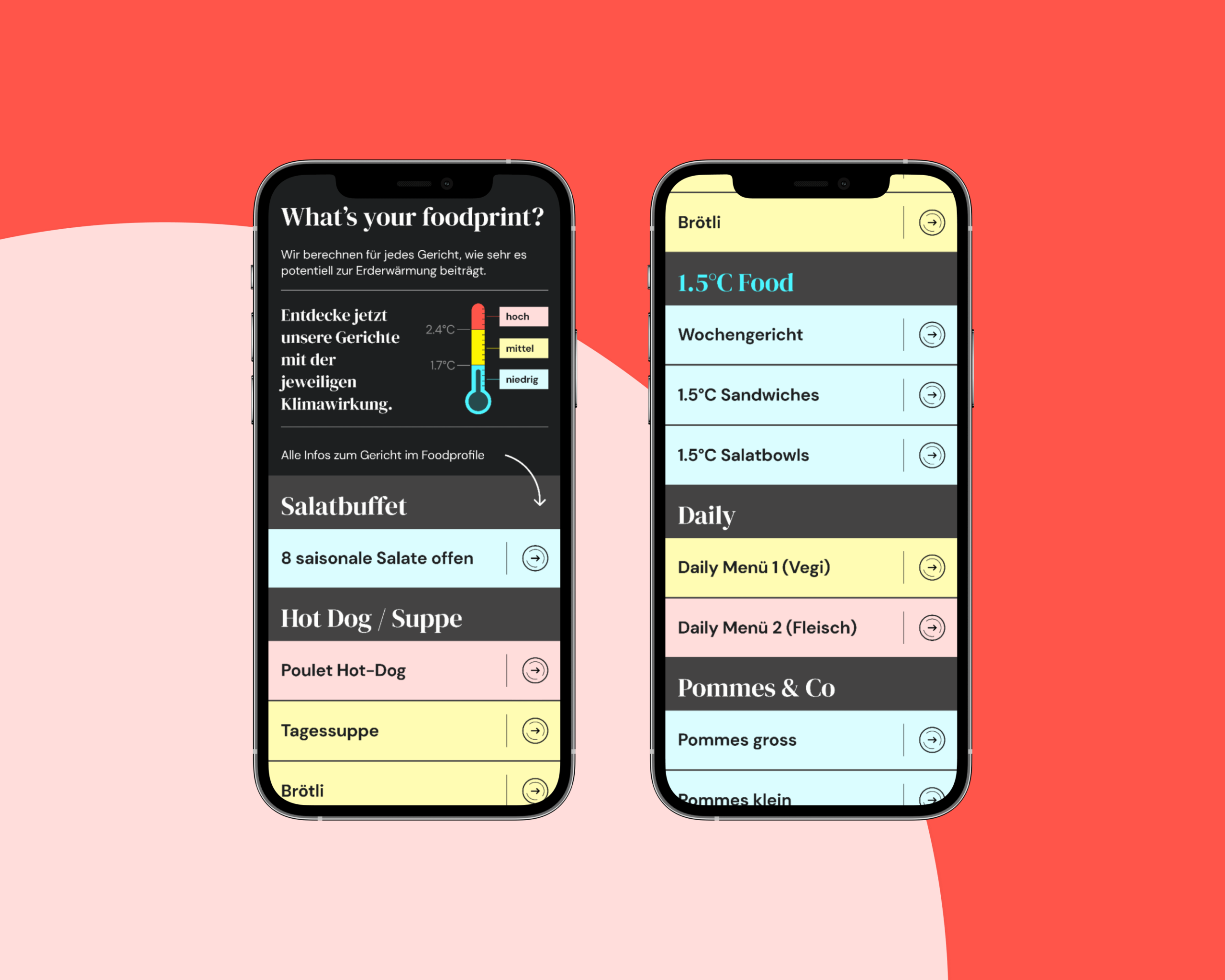
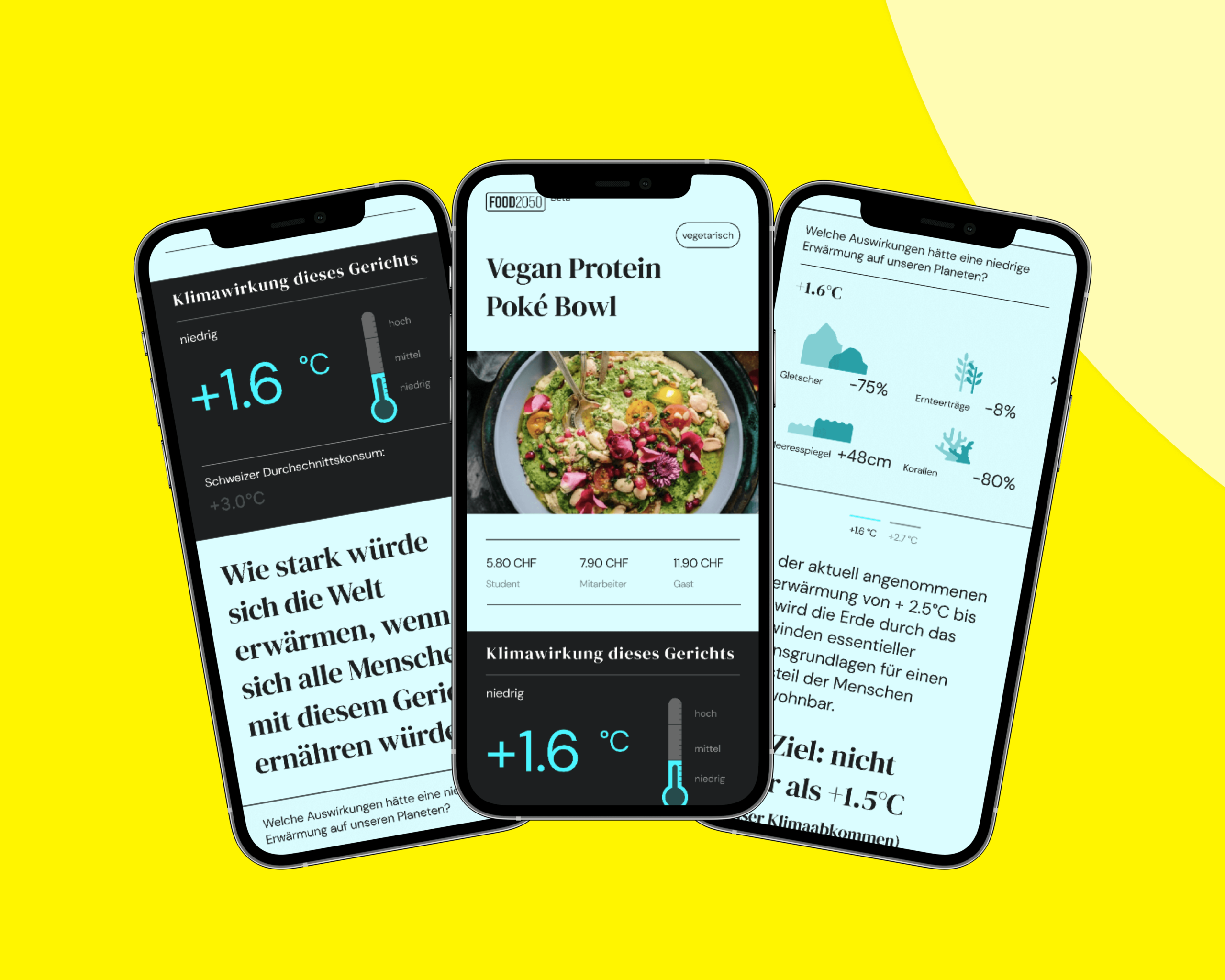
For canteens or cafeterias with a high volume of guests, the digital menu guidance system the decision-making process directly on site.
- Displays: A display on which the current dishes including QR code are visible simplifies the selection and leads to faster food serving at the POS.
- Transparency: Guests can call up detailed product information via QR codes. This empowers consumers to make the right purchasing decisions. This meets the growing need of many consumers for sustainable food.
- Feedback: The system can be used to rate menus and send comments to the restaurant.
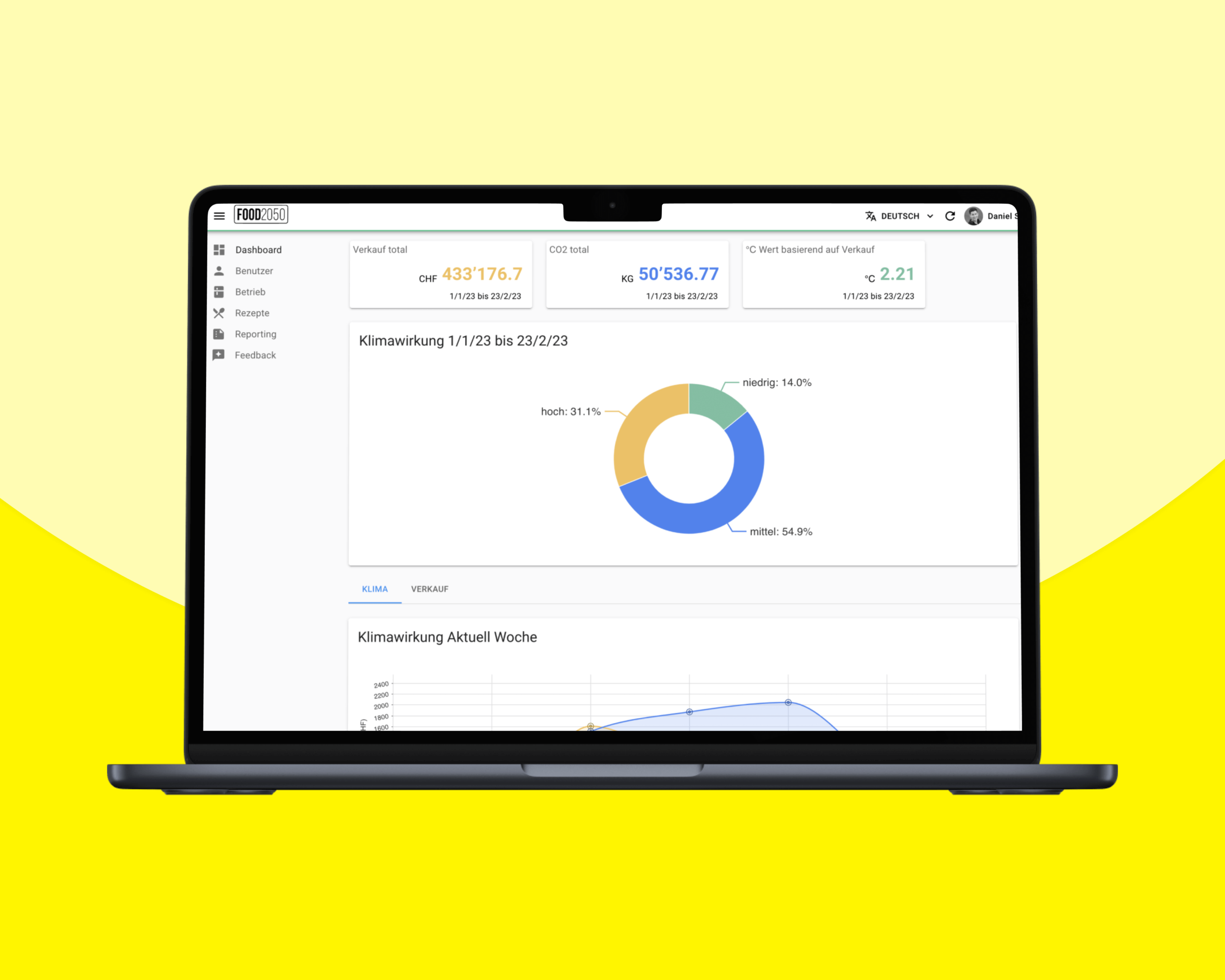
The menu navigation system also includes a dashboard for businesses, in which sales figures and CO2 values are presented. It thus actively supports businesses in menu planning and marketing their food offerings. Catering establishments can thus focus their offerings on menus with a minimal ecological footprint.
The technology behind the menu navigation system
FOOD2050 relies on a modern headless cloud architecture and open source software to provide the digital information system.
Backend
At its heart is a GraphQL API service based on Node.js.
- Prisma ORM: Enables the creation of a fast, scalable domain model and access to the Cloud SQL Postgres database.
- Hosting: The application is hosted on the Google Cloud in Switzerland to ensure data security.
Front end
The user interface uses technologies that are designed for speed:
- React & Next.js: Enable high-performance, SEO-optimized websites for end users.
- ReactAdmin: Serves as a basis for administration tasks and reporting, ideal for quickly scaling data-driven applications.
- Real-time visualization: Due to the large volume of data, a sophisticated solution was chosen to process real-time data and visualize the climate effects live.
Security
Access control is a critical aspect in the processing of sensitive business data. Firebase Auth is used for user identification. An implemented authorization system ensures that catering businesses only see their respective data. In addition, the ticker on the website aggregates the data in such a way that no conclusions can be drawn about individual restaurants. This also applies to consumer data collected during the checkout process.
Fewer emissions, more orientation: how the FOOD2050 menu guidance system benefits both sides
Digital solutions and sustainable nutrition are not contradictory, but complement each other perfectly.
By automatically calculating the ecological footprint and visualizing it clearly in degrees Celsius, a new level of transparency is created in community catering. Businesses gain valuable insights for planning and product ranges, while guests can see climate-friendly options at a glance.
This turns data into a dialog – and every menu into an opportunity to reduce your own impact. FOOD2050 thus makes a concrete contribution to a sustainable food culture.
Get in touch with us

Martin Mächler
Partner and Co-Founder
Interested?
Let’s talk.
Contact Martin now and benefit from his many years of experience for the success of your projects!