
Ob CRM, Excel, E-Mails oder Fachapplikationen: In vielen Unternehmen schlummern wertvolle Daten, verteilt über zig Systeme, die schwer zugänglich und oft ungenutzt sind. Ein Kunde von uns sagte mal sehr treffend:
"I always have to ask Ruedi, because this information is all stored in his inbox from the last 10 years."
Man sucht zwar im Intranet, findet aber vielfach eine lange Liste von Resultaten, die wenig aussagekräftig sind. Die Folge? Wichtige Entscheidungen werden nach Bauchgefühl getroffen, statt faktenbasiert.
Der CEO macht Druck und sagt, das sei doch alles ganz einfach. Man müsse nur das CRM an die LinkedIn-Seite koppeln und mit den E-Mails von Ruedi abgleichen, dann wüsste man alles. Die Welt ist doch vielfach etwas komplexer, und wimmelt von unterschiedlichen Berechtigungen, Dateiformaten und dem Mangel an APIs.
KI-Layer und Chat-Bot über alle Quellen hinweg
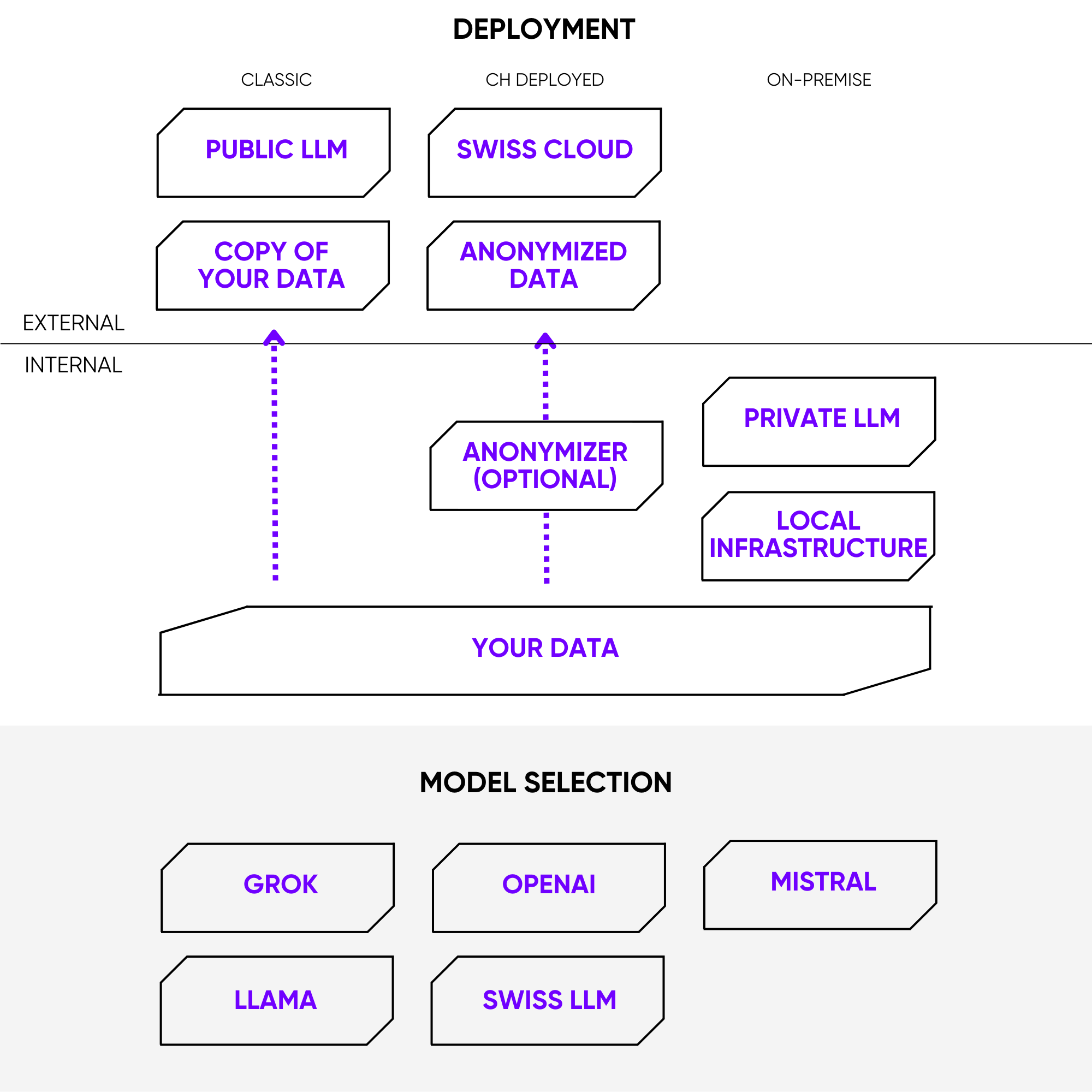
Hier bietet sich nun eine einmalige Chance mit dem Einsatz von KI. Mittels einem KI-Layer können verschiedene, sehr heterogene Datenquellen einfach integriert werden. Ähnlich wie ein Mensch, schafft man es sowohl semantische wie auch syntaktische Unterschiede unterschiedlicher Systeme gut zu überbrücken. Die Kunst bei solchen Lösungen besteht in der Auswahl der passenden KI-Modelle (bspw. das neue Schweizer Modell versus eines bekannten Internationalen). Der KI-Layer abstrahiert diese komplexen Architekturen und stellt ein einfaches API intern zur Verfügung.
Die zweite Stärke von KI ist, dass Mitarbeitende mittels Chatbot in natürlicher Sprache ihre Anliegen, einfachen Aufgaben und Abfragen formulieren können. Was früher spezielle Kenntnisse in Datenbanksprachen wie SQL oder Expertensysteme wie BI-Lösungen bedingte, ermöglicht nun jedermann die Interaktion mit spezialisierten Quellsystemen.
Mit Daten sprechen, statt lange zu suchen
It really is a bit like talking directly to data with AI. Instead of tediously struggling with formats and special queries, you now formulate directly in the chatbot – instead of “SELECT * FROM customers INNER JOIN sales”, you ask “Who bought product X in the last 12 months?”. ChatGPT shows how it’s done: instead of receiving countless links like a Google search, you receive a direct answer to a specific question. The big difference is that with Panter’s solution, internal company data can also be used securely, in compliance with Swiss data protection and legally protected.
Technisch geschieht dies durch eine Wahl einer KI-Architektur, welche auf die Vorgaben und Gegebenheiten der jeweiligen Organisation Rücksicht nimmt. Mit der Wahl eines (oder mehreren) KI-Modellen steuert man die Genauigkeit der Antwort (man baut damit den Kontext auf, für den spezifischen KI-Einsatz). Wie in anderen Gebieten ist es stets ein Trade-Off zwischen Genauigkeit und Aufwand. In den meisten Fällen genügt bereits die Qualität zu erreichen, die man von einem Praktikanten erwarten darf.
In einer Woche zum KI-Prototyp
A proof of concept (PoC) often only takes a week. After that, you know what is possible, can estimate the complexity of all data sources well and have already “prompted” (and tested) the first questions. Above all, it becomes clear where the added value for the organization lies and how complex the technically and legally correct connection of the most important data sources is. Within two months, an MVP is ready for productive use and can be used by employees without training. This is how long it usually takes to roll out and train an entire BI solution. Additional data sources can be added on a modular basis.
For contractual reasons, we are not allowed to mention all of our customers by name. However, Panter’s architectures are used by Wolfpak.ai, a large company with close ties to the federal government, a Swiss association, an insurance company and in the form of our own internal AI solution “Pantobot”.
Ein Beispiel eines Schweizer KMU
The manager of an SME operating throughout Switzerland approached us with the problem that a lot of data was available, but in systems that could only be accessed by individuals. There was a CMS with event data, a CRM with customer data, an internal drive and personal emails that were often used. Furthermore, it was not possible to adequately track changes in the customers’ VR.
For a PoC, we therefore took CSV exports of the most important systems, a private AI model (data protection) and connected it with Zefix and other public sources. Within days, we had a system that showed the value for the organization and demonstrated its feasibility. With the subsequent MVP, all employees now have access to a chatbot that answers their most important day-to-day questions. The quality of customer service has increased, events can be targeted precisely, changes in relevant customer relationships are visible, etc. And all this without anyone having to manually connect tens of pieces of data.
Eat your own dog food: Pantobot.
In Pantobot, we have implemented precisely this architecture ourselves and use both internal and external data sources. All employees have access to it and can use it in their daily work. Especially in project management, we see great simplifications in daily work, e.g. details of time recording, project reporting and requirements engineering have become much easier. The feedback from employees can be roughly summarized as follows:
- Schnellere Entscheidungen, weil die Antwort direkt kommt und in «normalem» Deutsch.
- Bessere Datennutzung, weil bis dato separate Silos nun verbunden sind.
- Entlastung von Experten, weil Wissen direkt geteilt und verfügbar ist.
- Neue Perspektiven, weil externe Quellen (z.B. Standortdaten, Zefix) zusätzlich verknüpft werden.
- Schweiz-konform, erfüllt somit datenschutzrechtliche Vorgaben und Compliance gemäss Schweizer Vorgaben.
Wir haben unsere Datensilos erfolgreich verbunden. Wären Sie neugierig zu erfahren, welches ungenutzte Potenzial sich freisetzen liesse, wenn auch Sie Ihre internen und externen Datenquellen intelligent miteinander verknüpfen würden? Kontaktieren Sie uns jetzt – in nur einer Woche zeigen wir Ihnen mithilfe eines Prototyps, welche verborgenen Schätze in Ihren Daten schlummern.